
How to Measure Economic Impact of a Community Event (Now with Receipt Check-In)
If you run events for a Main Street organization, Chamber of Commerce, downtown association, or DMO, post-event reporting is a familiar ritual. You’re asked how many people attended, how many emails were collected, how many passport check-ins occurred, and how many businesses participated. In most cases, you have those answers. Your team promoted the event, built the experience, tracked engagement, and pulled the reporting. From a participation standpoint, you did everything right.
But there is almost always one additional question:
What was the economic impact?
That is where the conversation becomes more difficult.
Engagement is measurable. Spending is not, at least not easily. Many organizations attempt to approximate economic impact using post-event Google Forms surveys, manual receipt submissions via email, voluntary business feedback, or estimated average spend per attendee. These methods are thoughtful and often the only tools available. However, they are time-consuming, inconsistent, dependent on voluntary reporting, and rarely complete enough to feel fully defensible in a funding conversation.
When a board member, city council representative, sponsor, or grant provider asks how much money was actually spent, most organizations are left providing an estimate. You may know the event felt successful. Businesses may report strong traffic. But translating that into documented economic impact has historically required guesswork.
Receipt Check-In was built to close that gap.
Introducing Receipt Check-In for Proxi Challenges
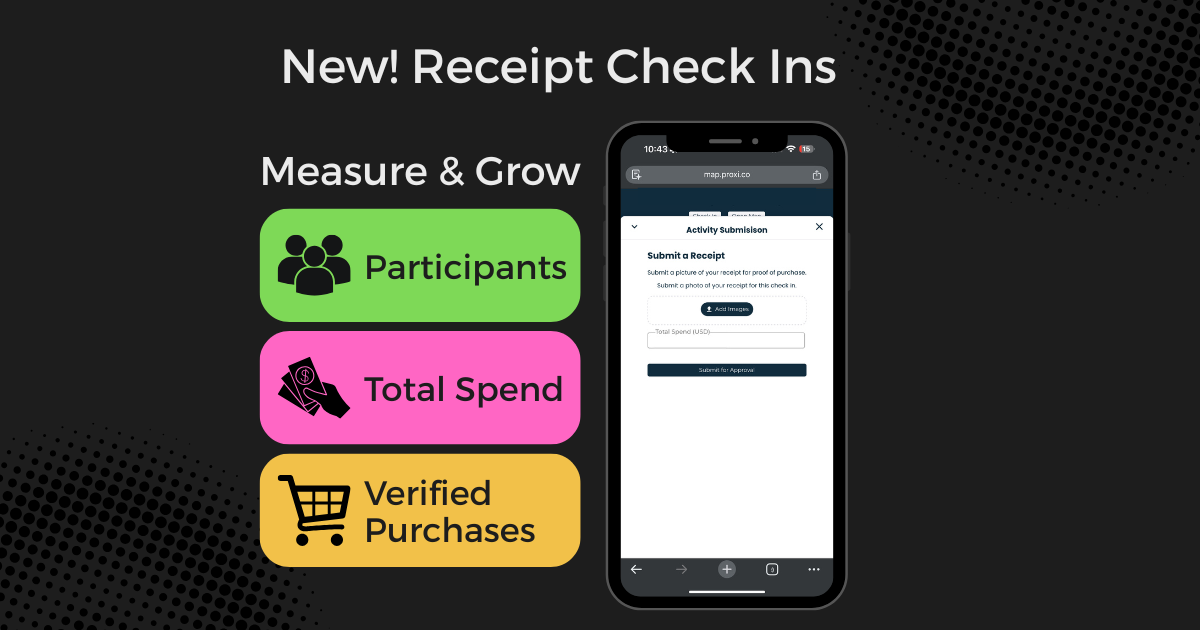
Proxi’s new Receipt Check-In feature allows participants to upload a receipt as proof of purchase during a passport event, scavenger hunt, or challenge. Instead of simply checking in at a location, participants complete a purchase and upload documentation directly within the experience.
This shift moves your reporting beyond foot traffic and engagement metrics. It allows you to track verified purchase activity tied directly to your activation.
In practical terms, that means you can measure:
- The number of verified transactions
- The number of participating businesses with confirmed purchases
- The percentage of participants who converted from engagement to spending
- Multi-business participation supported by receipts
- Documented economic activity during your event window
Instead of reporting that 1,200 people participated, you can report that 842 verified purchases occurred across 31 businesses during a defined timeframe. That is a fundamentally different conversation.
Why Economic Impact Reporting Matters More Than Ever
Community organizations operate in increasingly data-driven environments. Funding is competitive. Budgets are scrutinized. Sponsors expect measurable return. Grant applications require quantifiable outcomes. Boards and city leaders want to understand how programming contributes to economic vitality.
Economic impact is one of the core pillars of Main Street and downtown development work. Yet historically, it has been one of the hardest metrics to document.
Receipt-based verification strengthens:
- Annual impact reports
- Main Street America reporting submissions
- Sponsor renewal decks
- Grant applications and post-program reports
- City council presentations
- Budget justification conversations
When you can tie documented spending directly to your activation, you move from narrative to evidence. That distinction builds credibility.
A Clear Example: Restaurant Week
Restaurant Week illustrates the power of receipt-based tracking.
Traditionally, Restaurant Week reporting might include the number of participating restaurants, reservations booked, passport participation, and social media reach. These are valuable metrics, but they do not answer the central economic question: Did the activation drive revenue?
With Receipt Check-In enabled, you can require receipt uploads for prize eligibility, offer tiered rewards based on spend thresholds, and track verified transactions across participating businesses. This allows you to document economic activity rather than estimate it.
Instead of assuming an average spend per diner, you can measure verified purchase participation. Restaurant Week becomes more than a promotional event. It becomes a documented economic driver supported by structured data.
Strengthening Sponsor ROI Conversations
Sponsors invest in measurable outcomes. Engagement is important, but verified transaction data carries more weight.
With receipt-based tracking, you can report:
- Verified purchases at sponsor locations
- Conversion rates from participation to spending
- Comparative performance between sponsored and non-sponsored businesses
- Documented economic activity associated with sponsor exposure
This elevates renewal conversations. Rather than presenting impressions or foot traffic alone, you can demonstrate documented transactions linked to programming. That level of specificity increases sponsor confidence and long-term retention.
Improving Grant Competitiveness and Reporting
Many grants require demonstrated economic benefit to local businesses. Receipt uploads allow you to include language such as:
“During the 14-day activation period, participants uploaded 914 verified receipts across 28 small businesses, demonstrating documented local economic activity directly associated with program promotion.”
That statement is structured, measurable, and defensible. It reflects accountability. It signals that your organization is serious about outcomes, not just participation.
For organizations submitting annual Main Street America reporting or similar program documentation, this layer of verification enhances credibility.
Building Confidence with Boards and City Leadership
When presenting to city councils or boards, specificity matters. There is a meaningful difference between reporting that foot traffic appeared strong and reporting that 673 verified purchases totaling a documented amount occurred across participating businesses during the activation period.
The latter builds trust. It supports funding decisions. It positions your organization as an economic partner, not just a marketing facilitator.
Receipt Check-In turns events into economic case studies.
How Receipt Check-In Works in Practice
Within Proxi Challenges, you can add receipt upload as either a required or optional activity. You can design structured experiences such as:
- Multi-business spend challenges
- Restaurant Week prize drawings tied to verified purchases
Participants experience a streamlined process. Organizations gain structured reporting. Businesses benefit from documented transaction activity linked to your promotion.
Importantly, this system centralizes receipt validation within the challenge itself, eliminating the need for separate Google Forms, email submissions, or manual reconciliation processes.
Moving from Event Host to Economic Infrastructure
Receipt-based verification changes how your organization is perceived.
You are no longer simply organizing seasonal promotions or running passport crawls. You are documenting economic circulation. You are providing sponsor-grade analytics. You are supporting small businesses with measurable outcomes. You are building structured datasets that inform future programming decisions.
That shift elevates your organization’s strategic role within the community.
It signals operational maturity. It demonstrates accountability. It reinforces your position as a driver of economic vitality.
Beyond Dollars: Behavioral Insight
Receipt Check-In also provides insight into participant behavior. You can analyze the percentage of participants who convert from engagement to purchase, identify businesses that drive repeat visitation, and understand multi-location participation patterns.
This data informs smarter event design in the future. It clarifies which activations truly drive spending and which primarily generate awareness.
Economic impact measurement becomes not just a reporting function, but a strategic planning tool.
Why Now Is the Right Time
Communities increasingly expect measurable results. Engagement metrics remain important, but they are no longer sufficient on their own in high-stakes funding environments.
Verified economic impact strengthens your position with sponsors, grant providers, boards, and city leadership. It reduces reliance on estimates and surveys. It builds reporting confidence.
Receipt Check-In does not replace engagement tracking. It enhances it. It adds the missing layer that many organizations have struggled to capture in a scalable way.
Ready to Measure Economic Impact with Confidence?
If you are planning a Restaurant Week, downtown passport, seasonal promotion, or community challenge, consider enabling Receipt Check-In as part of your reporting strategy.
Engagement will always matter. Community participation will always matter. But documented local spending provides the clarity that many stakeholders now expect.
If you are planning to use Receipt Check-In, we would love to see how you are structuring your activation and help you design reporting that aligns with your board, sponsors, or grant requirements.
Schedule a demo to see Receipt Check-In in action, or start a challenge and enable receipt-based activities today.
Adventure Awaits!
Check out some of the latest articles on our blog