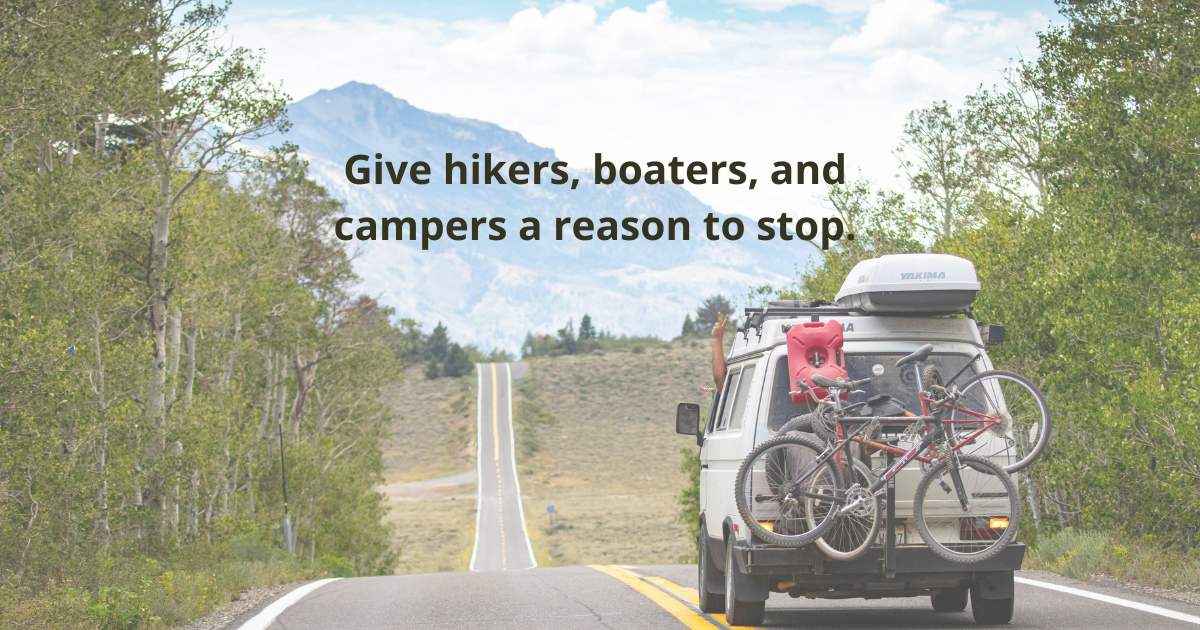
Someone finishes a hike, pulls the boat out of the lake, or breaks down camp for the day. They're tired, they're hungry, and more often than not, they're already wondering what's nearby. That's the moment most outdoor recreation towns lose, not because visitors aren't interested, but because there's no easy way for them to find out what's actually around.
If your community sits near trails, a lake, a river, or a campground, you already have the visitors. What you're often missing isn't the audience, it's a map that surfaces the opportunity. Recreational travelers are actively looking for a place to eat, a place to grab a drink, something to do before they head home. A well-built guide, easy to find whether it's a QR code at the trailhead or a printed postcard at the visitor center, is what puts those options in front of them.
Your town might already be a trail town
Trail towns are communities that sit near a hiking, biking, or paddling trail and actively pull that traffic off the trail and into local businesses. It's a well-documented economic development strategy, and the numbers back it up. Studies on trail spending put the average hiker at around fifty dollars per town visit, covering meals, groceries, lodging, and gear. One economic impact study on Virginia's Creeper Trail found that non-local trail users generated over a million and a half dollars for two counties in a single year.
The same logic applies whether your draw is a trail, a lake, a river, or a campground. Any town near a recreation asset has the same opportunity a trail town does. The visitors are already coming through. The only question is whether your downtown captures any of that spending.
It's not just hikers
Trailheads are the easiest example, but the same problem shows up at boat launches, lake access points, riverside put-ins, and campgrounds. Anyone finishing a day outdoors is standing around afterward with a little time to kill and no idea what's five minutes away. Paddlers pulling out at the boat ramp want the same thing a hiker wants: a cold drink, some food, maybe ice cream, without having to search for it on a phone with no signal. If you're only thinking about hikers, you're leaving the lake crowd, the river crowd, and the campground crowd on the table.
Make your guide easy to find, digital or in hand
The parking lot at the trailhead. The end of the trail. The boat launch. The campground check-in board. The postcard rack at the visitor center. These are all places people are standing still, actively looking for exactly this kind of guidance. That's where a QR code linking to your map, or a simple printed guide, does its best work. Scan it or pick it up, and instead of guessing, they see a curated list: where to get a beer, where to get ice cream, where to grab food, maybe a coffee shop that opens early for tomorrow's trip out. No driving in circles, no guessing.
With Proxi, you build this map once. Print QR codes for every access point in your area, trailhead parking lots, boat ramps, lake beaches, campground bulletin boards, and ranger stations, and print postcards or rack cards for the visitor center. Update the businesses on it anytime without reprinting a single sign.
Map the campground itself, not just what's around it
If you have a campground nearby, it deserves two layers on the map, not one. The first is the campground layout itself: sites, restrooms, showers, the check-in station, the dump station, whatever campers need to navigate once they arrive. The second is what's around it: the beer, ice cream, and food options a five or ten minute drive away. Put both on the same map and campers get everything they need in one place, from the moment they pull in to the moment they head into town for dinner.
Let businesses sweeten the deal
A listing is good. A listing with an actual reason to stop is better. Business owners can log into their own Proxi business profile and add a special offer just for recreation visitors: a discount for showing the map on their phone, a free scoop with any hike-day purchase, happy hour pricing timed to when boats usually come off the water. They control it themselves, no calls to your office needed, and they can turn it on or off whenever they want.
Turn a one-time visitor into someone you can reach again
A hiker who scans your QR code once is a nice moment. A hiker who scans it, sees your guide, and leaves their email or phone number on the way in is a lead you can actually use. Proxi lets you prompt visitors to share their contact info before or after they view the guide, no separate signup form needed. Now instead of a one-time interaction, you have a list you can text or email the next time there's a fall festival, a holiday shopping weekend, or any other reason to bring them back downtown.
Add a Passport Challenge for extra motivation
If you want to go further, layer in a Passport Challenge. Visitors who check in at two or three participating businesses after their hike, paddle, or campout could be entered to win local gear, a free meal, or a campsite upgrade next season. It turns maybe I'll stop into I want to finish this, and it gives you another natural moment to collect contact info as they register.
Give businesses the data to keep saying yes
Local business owners near outdoor recreation areas often don't think of themselves as part of that economy, even when they should. Bring them into the map and show them the numbers. Proxi's community impact tracking shows you views, clicks, and check-ins, so you can go back to a business owner six months later and say here's how many people found you through the recreation map. That's a much easier renewal conversation than a cold ask.
Building a recreation economy around your downtown
Trailheads, boat launches, lake beaches, riverside put-ins, campgrounds. Anywhere people finish an outdoor activity with time and money to spend, a well-placed map, a few QR codes, and businesses offering their own deals can turn that moment into real revenue for your downtown. Trail towns have been proving this model for years. There's no reason a lake town, a river town, or a campground town can't do the same. The visitors are already coming. Give them a map, capture their info while you have their attention, and they'll spend the money, and stay in touch, long after they've driven home.
Adventure Awaits!
Check out some of the latest articles on our blog